
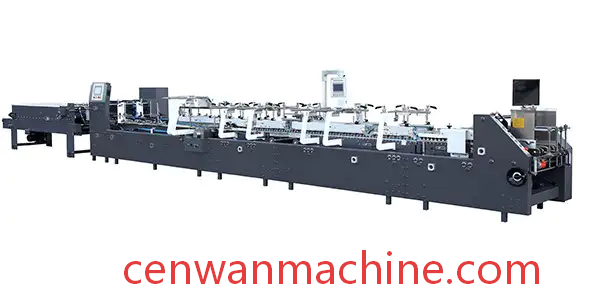
A packaging plant supervisor watches the gluing line, noticing two workers stationed at the machine. One feeds blanks while the other inspects finished boxes and clears occasional jams. This observation raises a practical question about workforce utilization. Can one person manage the entire Box Gluing Machine operation, or does the equipment inherently require a dedicated team? The answer depends on equipment design, production demands, and operator skill. CenwanMachine, operated by Wenzhou Cenwan Machinery Co., Ltd., demonstrates how thoughtful engineering can reduce staffing needs without sacrificing output quality.
The automation level integrated into a Box Gluing Machine fundamentally determines its operator requirements. Basic models with manual feeding and simple control systems typically demand continuous attention from at least two individuals. One operator positions blanks into the feed section, ensuring proper alignment and spacing. Another worker monitors the delivery end, removing rejects and stacking finished products. This arrangement creates a production bottleneck because both stations require constant human presence. Manufacturers like CenwanMachine address this challenge through comprehensive automation that minimizes manual intervention at every stage.
Automatic feeding systems substantially reduce the operator burden at the input side. Modern Box Gluing Machine designs incorporate pile feeders that automatically separate and transport individual blanks into the folding and gluing section. These systems utilize suction cups, air blasts, and mechanical separators that handle varied material thicknesses without manual adjustment. Once the feeder receives proper settings, it operates continuously, freeing one operator to focus on quality monitoring rather than repetitive loading. The automatic feeder transforms the operator's role from physical laborer to production supervisor, directly impacting staffing numbers.
Pre-folding stations and alignment guides further minimize the need for constant oversight. These components prepare the blank for main folding operations, creating precise creases and ensuring proper orientation before glue application. By stabilizing material flow, these features prevent misfeeds and skewing that would otherwise require immediate operator correction. A Box Gluing Machine with robust material handling allows a single operator to manage the entire line, because the equipment maintains consistent throughput without frequent intervention. The operator shifts attention between feed and delivery ends, catching issues before they escalate.
Control system sophistication directly influences crew requirements. Touch-screen interfaces with preset recipes for different box styles enable rapid changeovers without extensive operator training or additional assistance. The operator selects the appropriate box design from the stored library, and the machine automatically adjusts folding plates, glue nozzles, and pressure rollers. This automation eliminates lengthy setup procedures that previously required two persons measuring, adjusting, and testing each parameter manually. Reduced setup time means less downtime and fewer staffing demands, because the operator executes the changeover alone.
Quality assurance systems integrated into the Box Gluing Machine provide another avenue for labor reduction. Vision inspection cameras and sensors monitor glue application patterns, fold accuracy, and final box dimensions. These systems detect defects in real-time, automatically ejecting faulty products without requiring an operator to visually inspect each unit. The machine flags recurring issues, alerting the operator only when adjustments become necessary. This intelligent monitoring transforms the operator's role to exception handling rather than constant inspection, enabling one person to supervise multiple machines or focus on production optimization.
Machine reliability and maintenance requirements play a crucial role in staffing decisions. A Box Gluing Machine that experiences frequent jams, adhesive buildup, or mechanical failures demands additional personnel for troubleshooting and cleaning. The operator must stop production, clear the obstruction, restart the line, and sometimes call for maintenance support. These interruptions multiply the effective labor requirement, because the machine cannot run unattended during fault conditions. Robust engineering that minimizes common failure points reduces these interruptions, allowing single-operator supervision throughout most production runs.
Production volume and box complexity determine whether one operator suffices. High-speed lines producing straight-line cartons allow a single experienced operator to handle both feeding and collection points effectively. The predictable material flow and straightforward folding pattern provide ample time between actions. Conversely, complex lock-bottom boxes or multi-panel designs may require additional attention, potentially justifying a second operator for quality verification. The operator's skill level becomes a critical variable, because trained personnel anticipate issues and react quickly, compensating for machine limitations through proactive management.
Workplace layout and material handling systems influence crew size. Ergonomic placement of raw material pallets and finished box collection areas reduces unnecessary movement. Conveyor systems that transport finished products to downstream equipment eliminate the need for an operator to manually stack and move boxes. When the Box Gluing Machine integrates smoothly into the overall production flow, the operator's duties concentrate exclusively on the machine itself. This focused responsibility permits single-person operation, because peripheral tasks no longer consume attention.
CenwanMachine provides equipment that addresses each of these staffing considerations. The automatic feeder, intelligent controls, and reliable construction reduce the operator burden to manageable levels for many production scenarios. The manufacturer's experience across forty countries informs designs that balance automation with practical usability. When evaluating a Box Gluing Machine purchase, the thoughtful production manager assesses not just the purchase price but the ongoing labor costs that accompany each equipment choice. A machine that functions effectively with one operator saves salaries, training expenses, and management overhead across its entire service life. At https://www.cenwanmachine.com/product/, prospective buyers find detailed specifications and configuration options that illustrate real-world staffing outcomes. The information transforms an abstract operational question into concrete financial analysis. The final decision rests on comparing production requirements, operator capabilities, and the specific automation features that each machine offers. Ultimately, the question shifts from "how many crew members?" to "which equipment configuration maximizes my available workforce's potential without compromising quality?"

 English
 Arabic
 French
 Spanish
 Portuguese
 Turkish
 Dutch
Dutch
 Italiano
 Russian
 Romaian
 Portuguese (Brazil)
 Greek
Greek