
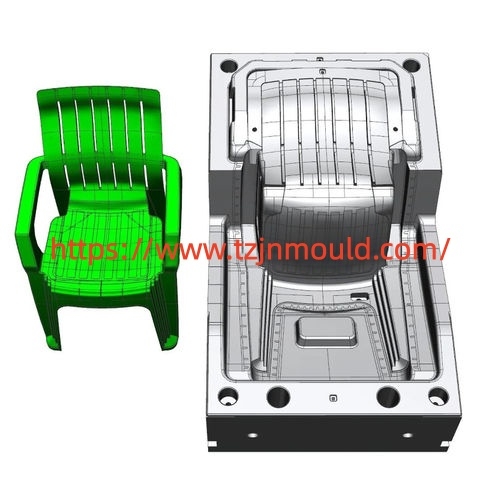
Plastic Chair Mold cooling systems sit in a place that often feels invisible at first, but once production starts running, everything seems to circle back to them. In a busy workshop, you can hear machines cycling again and again, and behind that rhythm there is always heat moving through steel, waiting to be controlled. JingnanMould pays attention to this part early, not because it looks complicated on paper, but because it changes how everything behaves once production begins.
Inside the cavity, melted material spreads fast, then slows as it starts losing energy. If that cooling phase feels uneven, the shape does not settle cleanly. You might see slight bending, or surfaces that do not feel as steady as expected. Nothing dramatic at first, just small shifts that grow more obvious after repeated cycles. That is usually where engineers start looking closer at the cooling layout.
Factories tend to focus on this system because timing matters more than people expect. A few seconds longer in cooling, and the whole rhythm of production shifts. Multiply that across hundreds of cycles and it becomes noticeable in output consistency and machine scheduling. So cooling is not just about lowering temperature. It is about keeping the pace of production from drifting.
There is also the way heat spreads differently in different areas of the tooling structure. Thick sections hold warmth longer, thin areas release it faster. Without a thoughtful cooling path, that difference turns into stress inside the finished part. Over time, that stress can show up as slight deformation or uneven surfaces. Engineers try to balance this by guiding flow in a way that feels steady rather than forced.
In real factory environments, cooling channels also deal with something less visible but very practical. Small particles in water lines, gradual buildup, and pressure changes can all affect how smoothly heat is removed. When flow weakens, the change is not always immediate, but production starts to feel less predictable. That is why maintenance teams often check cooling performance before anything else when output looks off.
JingnanMould approaches this part of design with a focus on behavior over time. Instead of only thinking about how a system works on day one, the design process also considers what happens after long running cycles. Flow stability, channel placement, and material response all get reviewed together. It is less about a fixed formula and more about watching how heat actually behaves inside a working system.
Sometimes simulation tools are used before anything is built. They show how heat moves, where it lingers, where it escapes too quickly. But even with those tools, the real test comes later, when the mold is running and production is steady. That is when small adjustments matter most, like changing a flow direction or refining a cooling passage.
Factories do not always talk about cooling systems in detail, but they feel the difference when it is well balanced. Machines run with fewer interruptions, surfaces come out more consistent, and operators do not need to adjust settings as often. It is a quiet kind of stability, the kind that does not draw attention but keeps everything moving.
Over time, cooling design becomes part of the rhythm of production itself. It is not just a technical feature sitting inside the tool. It is part of how the entire system stays predictable from one cycle to the next. JingnanMould keeps this in focus when shaping tooling solutions, aiming for steady behavior rather than sudden changes in performance.
More details can be found at https://www.tzjnmould.com/

 English
 Arabic
 French
 Spanish
 Portuguese
 Turkish
 Dutch
Dutch
 Italiano
 Russian
 Romaian
 Portuguese (Brazil)
 Greek
Greek