
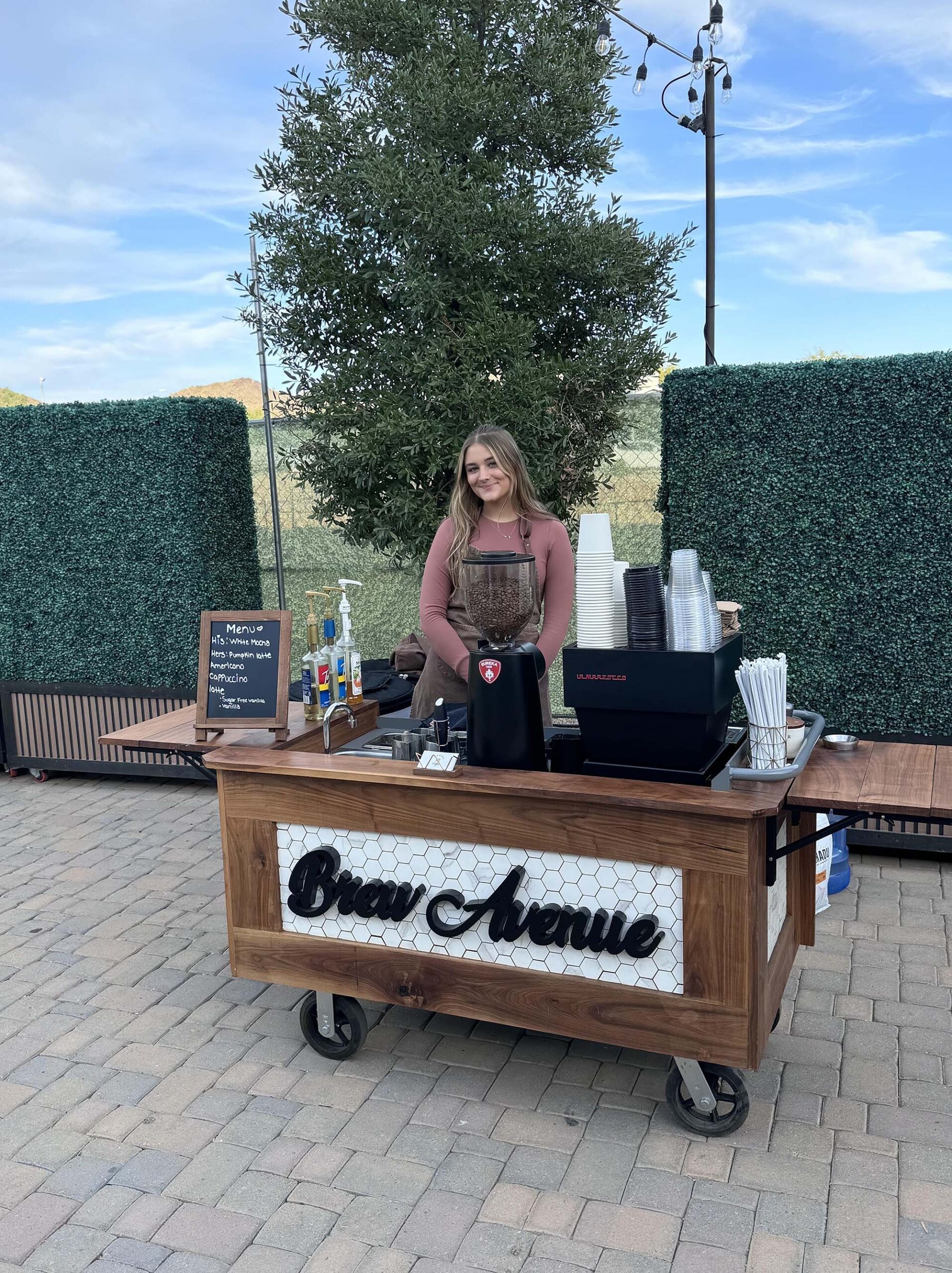
A line of 75 guests stretches from the cart. The espresso machine beeps for a refill. Someone asks for oat milk, another wants extra hot, a third forgot their wallet. In the chaos, the barista must stay calm, fast, and friendly. High‑pressure, high‑volume event service is nothing like a cafe shift. It demands a unique set of skills: split‑second prioritization, emotional regulation, and physical stamina. Without proper training, even experienced baristas crack. That is why professional coffee catering requires a dedicated training program. Brew Avenue Coffee has built one. We are located in Phoenix, Arizona, United States, and our baristas thrive where others crumble.
Why Event Barista Training Is Different
A cafe barista works a predictable shift. Rushes come and go. There is backup staff. Mistakes can be corrected. An event barista faces a single, massive rush with no relief. The cart is the only coffee source. Every second counts. Consequently, training must focus on resilience, workflow, and split‑tasking.
Our coffee catering Service trains baristas specifically for events—not for cafe work. We start with a brutal assessment: can they handle simulated chaos? Then we build from there.
The Four Pillars of High‑Volume Training
Pillar 1: Muscle Memory Through Relentless Drills
When stress spikes, conscious thinking slows. Baristas must rely on automatic movements. We drill the core workflow until it is second nature: grind, tamp, pull, steam, pour. Each motion is broken into micro‑steps. Trainees practice for hours without serving a single guest.
We also simulate high‑volume scenarios. A trainer shouts orders rapid‑fire: “Latte oat milk! Double espresso! Cold brew with vanilla! Decaf cappuccino!” The trainee executes without a menu in front of them. Mistakes are corrected immediately. By week two, they can produce 60 consistent drinks per hour.
Pillar 2: Queue Management and Communication
A long, chaotic line stresses everyone—including the barista. Our baristas learn to “own the line.” They make eye contact with the next guest, acknowledge them (“I’ll be right with you”), and keep moving. They also learn to split the line: “Espresso drinks to the left, cold brew to the right.”
Because we are located in Phoenix, Arizona, United States, we also train for heat‑induced impatience. Baristas are taught to offer chilled water to waiting guests and to apologize for wait times proactively. A simple “Thank you for your patience” defuses tension.
Pillar 3: Emotional Regulation Under Fire
Stress triggers physical reactions: racing heart, shallow breathing, clenched jaw. We teach baristas to recognize these signs and use 10‑second resets: a deep breath, a shoulder roll, a sip of water. We also practice “reframing”—seeing a long line as a compliment, not a crisis.
Role‑playing difficult guests is mandatory. A trainer acts as an angry, demanding customer. The trainee practices de‑escalation: “I hear you. Let me get that right now.” No arguing. No defensiveness. This skill alone prevents meltdowns.
Pillar 4: Physical Stamina and Ergonomics
High‑volume events are physically brutal. Baristas stand for hours, lift heavy milk jugs, and repeat the same motions hundreds of times. We train proper body mechanics: lifting with legs, keeping wrists straight, using both hands symmetrically. Our cart is ergonomically designed, but we also require a fitness component: 30 minutes of continuous simulated service without rest. Those who cannot pass do not work large events.
The Training Timeline
We do not throw new baristas into the fire. Our program lasts four weeks:
-
Week 1: Coffee fundamentals and workflow drills (no guests)
-
Week 2: Low‑volume events (under 50 guests) with a supervisor
-
Week 3: Medium‑volume events (50‑150 guests) solo but monitored
-
Week 4: High‑volume events (150+ guests) with a mentor present
Only after 20 successful high‑volume shifts does a barista qualify for solo large events.
Real‑World Stress Simulation
We host quarterly “stress tests.” We invite 100 volunteers (friends, family, other baristas) to form a chaotic line. They shout conflicting orders, change their minds, and complain about wait times. Trainees must serve 200 drinks in 90 minutes. Cameras record everything. Afterward, we review footage and provide feedback.
This simulation has cut our error rate by 60% during actual high‑volume events. It also identifies baristas who need more support before they ever face a real crowd.
Supporting Baristas on Event Day
Training alone is not enough. We also provide:
-
Cooling vests for summer events (ice‑pack inserts)
-
Hydration breaks every 45 minutes (mandatory)
-
Two‑barista minimum for events over 150 guests
-
A dedicated “floater” for events over 300 guests (restocks, handles complaints)
Because we are located in Phoenix, Arizona, United States, we also monitor heat stress and will pause service if temperatures exceed safe levels. A trained barista is useless if they collapse.
Conclusion
High‑volume event stress can break even experienced cafe baristas. But with deliberate training—muscle memory, queue management, emotional regulation, and physical stamina—they can thrive. Brew Avenue Coffee’s rigorous program produces baristas who stay calm, fast, and friendly when the line snakes around the block. Whether you need service for a public food festival, a business party, or a private wedding, our team is ready for the rush. We are located in Phoenix, Arizona, United States, and we train like our reputation depends on it—because it does.
Frequently Asked Questions
1. How long does it take to train a new barista for high‑volume events?
Our program takes four weeks, including supervised shifts. Experienced cafe baristas may transition faster but still need event‑specific training.
2. What is the most common stress mistake?
Rushing and sacrificing quality. New baristas speed up but make errors (wrong milk, wrong syrup). We emphasize “smooth is fast.”
3. Do you train baristas for non‑coffee drinks like tea?
Yes. Our training covers all menu items, including matcha, chai, and hot chocolate. Stress affects tea brewing too.
4. How do you handle a barista who cannot cope with stress?
We move them to low‑volume events or behind‑the‑scenes roles (prep, stocking). Not everyone is suited for the front line.
5. Can you provide extra baristas for very large events?
Absolutely. We staff one barista per 75‑100 guests per hour. For a 400‑guest event, we recommend four baristas or two carts.
6. How far in advance should I book to ensure trained staff availability?
For peak season, book 4‑6 weeks ahead. For large events (300+ guests), 8 weeks.

 English
 Arabic
 French
 Spanish
 Portuguese
 Deutsch
 Dutch
Dutch
 Italiano
 Russian
 Romaian
 Portuguese (Brazil)
 Greek
Greek