
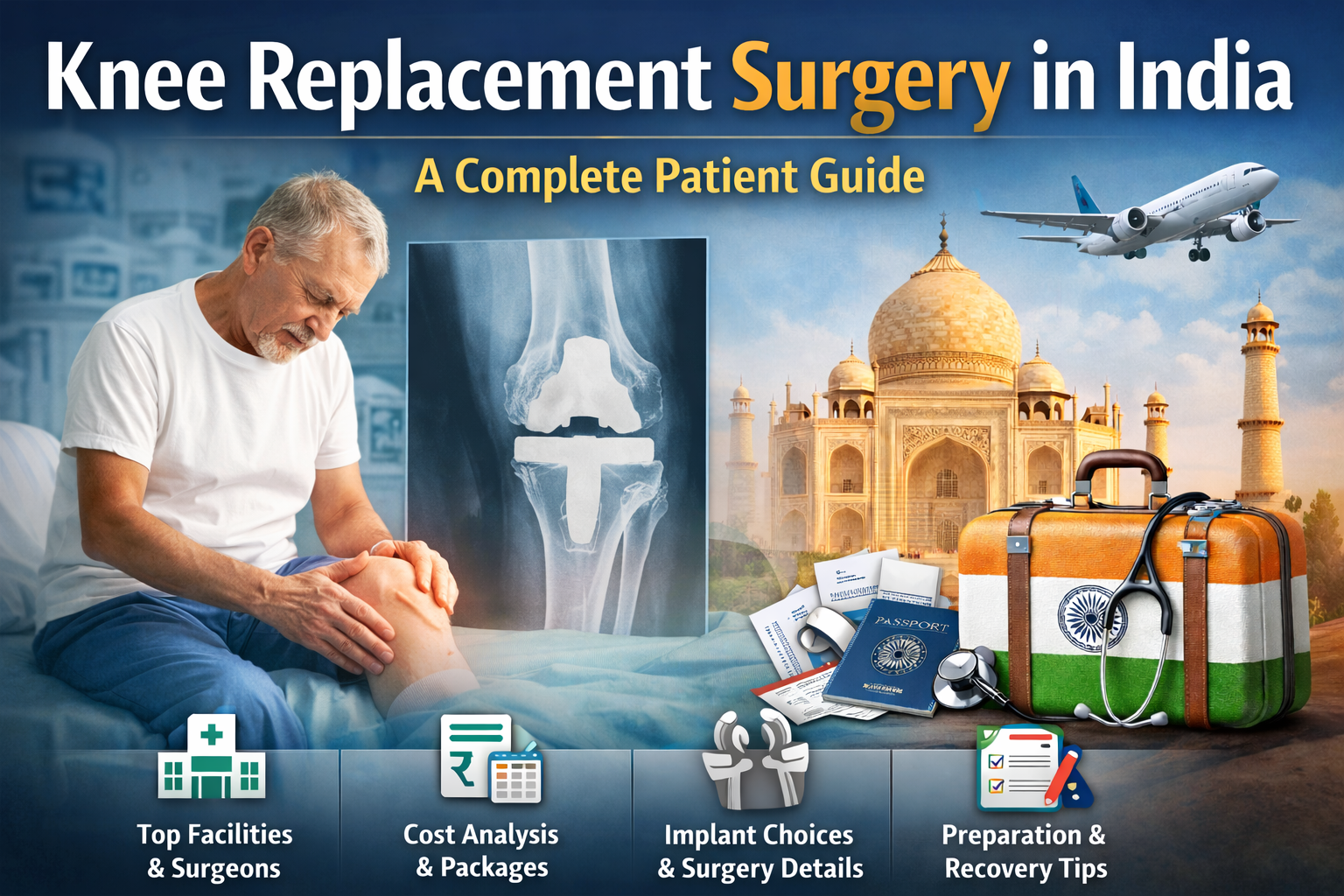
Knee pain that stops you from walking properly, climbing stairs or sleeping through the night is not a quality-of-life issue - it's a functional disability. For patients with severe knee osteoarthritis or post-traumatic joint damage, total knee replacement is often the only intervention that can genuinely restore mobility and eliminate chronic pain.
The problem, for many patients, is access. In some countries, the wait time for knee replacement surgery through public healthcare runs to a year or more. In others, the out-of-pocket cost is prohibitive for anyone without comprehensive insurance. India has become a primary destination for knee replacement because it solves both problems.
What Knee Replacement Surgery Involves
Total knee replacement (TKR) is a surgical procedure in which the damaged surfaces of the knee joint - the ends of the femur (thigh bone) and tibia (shin bone), along with the underside of the patella (kneecap) in many cases - are removed and replaced with metal and plastic implants. These implants recreate the smooth, functional joint surface that arthritis has destroyed.
The goal is straightforward: eliminate the bone-on-bone contact that causes pain, restore the mechanical alignment of the leg and give the patient a stable joint that allows normal movement.
The surgery is performed under spinal or general anesthesia and typically takes one to two hours. Most patients are helped to stand and take their first steps within 24 to 48 hours of surgery. This early mobilization is not pushed for convenience - it is a clinically established part of recovery that reduces complications and speeds healing.
Unilateral Versus Bilateral Replacement
Some patients have severe arthritis in both knees. There are two approaches: treating one knee at a time (staged bilateral replacement) or treating both in the same surgical session (simultaneous bilateral replacement).
The right approach depends on the patient's overall health, age, cardiac fitness and surgeon preference. Simultaneous bilateral replacement has the advantage of a single anesthesia event and a single recovery period. Staged replacement is often preferred in older patients or those with other health conditions because it is less demanding on the body. Your surgical team will assess which approach is appropriate for you.
Implant Options and What They Mean for You
Not all knee implants are the same. The major decisions involve:
-
Implant brand and design: Leading global implant manufacturers - Zimmer Biomet, Stryker, DePuy Synthes - are all available at major Indian hospitals. These are the same implants used at top hospitals in the USA, UK and Europe. Your surgeon will recommend a specific implant based on your anatomy, age, activity level and bone quality.
-
Cemented versus uncemented fixation: Cemented implants use surgical bone cement for immediate fixation. Uncemented implants rely on bone growing into the implant surface over time. Cemented fixation is more common in older patients; uncemented is sometimes preferred for younger, more active patients with good bone quality.
-
Standard versus high-flexion designs: High-flexion implants are designed to allow greater bending of the knee, which is particularly important for patients who sit cross-legged or kneel regularly - a relevant consideration for many patients from South Asian, Middle Eastern and African cultural backgrounds.
Discuss implant choice with your surgeon in advance. A good surgeon will explain the options and their reasoning.
Robotic-Assisted Knee Replacement
Several top Indian orthopedic centers now offer robotic-assisted knee replacement using systems like Mako (Stryker). Robotic assistance does not mean the robot performs the surgery - it means the surgeon uses a robotic arm and real-time 3D imaging to execute the pre-planned surgical cuts with greater precision than manual techniques alone can achieve.
The proposed benefits are more precise implant positioning, better soft tissue balance and potentially better long-term outcomes. Whether robotic assistance is right for your case depends on the specifics - discuss it with your surgeon.
The Recovery Timeline
Recovery from knee replacement follows a fairly predictable path, though individual variation exists:
-
Days 1–2: First physiotherapy session, standing and walking with support begins
-
Days 3–5: Increasing mobility, stair climbing practice begins
-
Days 5–7: Discharge from hospital in uncomplicated cases
-
Weeks 2–6: Continued physiotherapy, progressive increase in walking distance and daily activities
-
3–6 months: Most patients reach near-full functional recovery
-
12 months: Final outcome assessment - the implant is settled, scar tissue has matured and the full benefit of the surgery becomes clear
The first few weeks of physiotherapy are critical. Do not underestimate this phase. The surgery creates the mechanical conditions for a good knee - physiotherapy is what converts that into actual function.
What to Bring and Plan For
If you are traveling to India for knee replacement, practical preparation matters:
-
Bring all prior imaging - X-rays, MRI scans - and medical history including other conditions and current medications
-
Plan to stay in India for a minimum of three to four weeks post-surgery before flying home
-
Arrange accommodation that is accessible - not multi-story without an elevator, not too far from the hospital
-
Have a companion with you throughout the trip
-
Arrange for physiotherapy continuation at home before you leave India
Long-Term Expectations
Modern knee implants are designed to last 15 to 20 years or more in the majority of patients. Realistic expectations after surgery:
-
Significant pain relief - most patients report this as the most impactful change
-
Improved walking ability and endurance
-
Return to low-impact activities like walking, swimming, cycling
-
High-impact activities like running and jumping are generally not recommended with knee implants
For patients considering treatment abroad, services such as Divinheal can assist with hospital selection, surgeon coordination, and overall treatment planning.
If you have been living with severe knee pain and limiting your life because of it, knee replacement in India is a well-established, well-supported pathway to genuine functional improvement.

 English
 Arabic
 Spanish
 Portuguese
 Deutsch
 Turkish
 Dutch
Dutch
 Italiano
 Russian
 Romaian
 Portuguese (Brazil)
 Greek
Greek