
High-rise buildings are the backbone of modern urban infrastructure. From commercial towers to residential skyscrapers, these structures demand precision, strength, and efficiency at every stage of construction. One of the most critical aspects of high-rise construction is steel reinforcement, and this is where bar bending machine play a vital role.
In today’s fast-paced construction environment, manual bending methods are no longer sufficient. Contractors and engineers rely on advanced machinery to ensure accuracy, reduce labor costs, and meet tight project deadlines. This article explores the importance, applications, and benefits of bar bending machines in high-rise building construction.
What is a Bar Bending Machine?
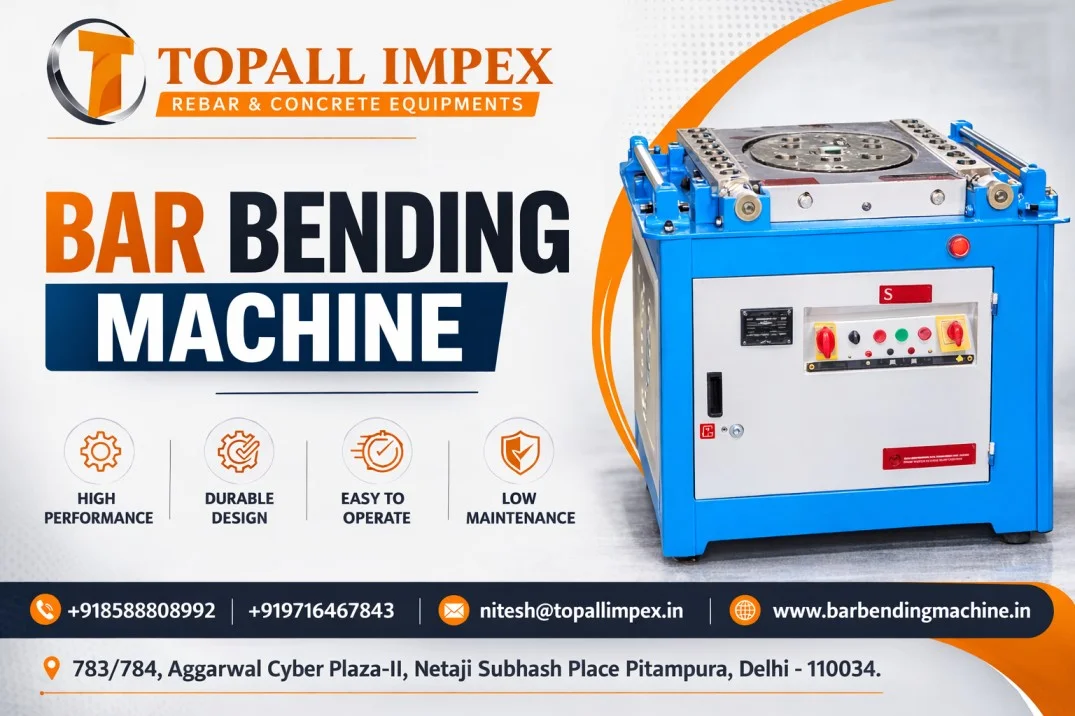
A bar bending machine is a construction tool used to bend steel reinforcement bars (rebars) into specific angles and shapes required for structural frameworks. These machines are designed to handle different diameters of steel bars and provide consistent, precise bending.
They are widely used in:
- Residential projects
- Commercial buildings
- Bridges and flyovers
- High-rise and mega infrastructure projects
Importance of Bar Bending in High-Rise Construction
High-rise buildings depend heavily on Reinforced Cement Concrete (RCC) structures. Steel bars are bent into various shapes to create frameworks that support beams, columns, slabs, and foundations.
Key reasons why bending is critical:
- Ensures structural integrity
- Provides load-bearing strength
- Helps in forming complex architectural designs
- Improves earthquake resistance
Without proper bending, the entire structural stability of a high-rise building can be compromised.
Role of Bar Bending Machines in High-Rise Projects
1. Precision and Accuracy
High-rise construction requires exact measurements and angles for reinforcement bars. Even minor errors can lead to structural issues.
Bar bending machines:
- Deliver uniform bends
- Reduce human error
- Maintain design specifications
This level of precision is crucial for multi-story buildings where consistency is key.
2. Faster Construction Speed
Time is a critical factor in high-rise projects. Delays can significantly increase project costs.
Using bar bending machines:
- Speeds up the bending process
- Handles bulk production efficiently
- Reduces project timelines
Compared to manual bending, machines can increase productivity by 3–5 times.
3. Reduction in Labor Dependency
Manual bending requires skilled labor and physical effort. In large projects, this can be costly and inefficient.
Bar bending machines:
- Reduce dependence on manual workers
- Lower labor costs
- Minimize fatigue and errors
This is especially beneficial in urban areas where labor costs are high.
4. Enhanced Safety on Construction Sites
Safety is a major concern in high-rise construction. Manual bending can lead to injuries due to improper handling of heavy steel bars.
Machines offer:
- Safer operations
- Controlled bending mechanisms
- Reduced risk of accidents
This helps contractors maintain better safety standards on-site.
5. Capability to Handle Heavy-Duty Work
High-rise buildings use thick and heavy reinforcement bars that are difficult to bend manually.
Bar bending machines can:
- Bend large diameter bars (up to 40mm or more)
- Maintain consistency in heavy-duty operations
- Work continuously without performance drop
This makes them ideal for large-scale infrastructure projects.
Applications in High-Rise Construction
Bar bending machines are used at multiple stages of construction:
1. Foundation Work
- Bending bars for footings and base structures
- Ensuring strong load-bearing capacity
2. Column Reinforcement
- Creating vertical frameworks
- Maintaining alignment and strength
3. Beam and Slab Construction
- Bending bars into stirrups and shapes
- Supporting horizontal load distribution
4. Shear Walls and Core Structures
- Essential for elevator shafts and staircases
- Improves building stability
Types of Bar Bending Machines Used
1. Manual Bar Bending Machines
- Suitable for small-scale projects
- Cost-effective but labor-intensive
2. Semi-Automatic Machines
- Balance between cost and efficiency
- Common in medium-scale construction
3. Fully Automatic Machines
- High-speed and highly accurate
- Ideal for high-rise and large projects
4. CNC Bar Bending Machines
- Computer-controlled precision
- Used in advanced infrastructure projects
Benefits of Using Bar Bending Machine
1. Improved Efficiency
Machines streamline operations and reduce downtime.
2. Cost Savings
Lower labor costs and reduced material wastage.
3. Consistent Quality
Uniform bends ensure better structural reliability.
4. Scalability
Easily handle large volumes of work in high-rise projects.
5. Reduced Material Waste
Accurate bending minimizes steel wastage.
Challenges Without Bar Bending Machines
Relying on manual methods in high-rise construction can lead to:
- Inconsistent bending
- Increased labor costs
- Slower project completion
- Higher risk of structural defects
- Safety hazards
This clearly highlights why machines are no longer optional but essential.
Future of Bar Bending Machines in High-Rise Construction
With the rise of smart cities and mega infrastructure projects, the demand for advanced construction equipment is increasing.
Future trends include:
- Automation and robotics integration
- AI-based precision bending
- Energy-efficient machines
- IoT-enabled monitoring systems
These innovations will further enhance productivity and accuracy in high-rise construction.
Conclusion
Bar bending machine have become an indispensable tool in high-rise building construction. They not only improve efficiency and accuracy but also ensure safety and cost-effectiveness.
As construction projects grow in complexity and scale, the role of these machines will continue to expand. For contractors and builders aiming to stay competitive, investing in modern bar bending technology is no longer a choice—it’s a necessity.

 English
 Arabic
 French
 Spanish
 Portuguese
 Deutsch
 Turkish
 Dutch
Dutch
 Italiano
 Russian
 Romaian
 Greek
Greek